

Jannik Sinner and Carlos Alcaraz have established the defining rivalry in men’s tennis. However, comparing their overall career achievements is not enough to determine who is better suited to win the US Open.
New York presents a specific challenge involving outdoor hard courts, demanding late-summer conditions, intense night sessions and the physical toll of winning seven best-of-five-set matches. A complete comparison must therefore consider their previous US Open performances, potential draws, playing styles, serving and returning, physical durability, tactical adaptability and preparation immediately before the tournament.
Their US Open Records Tell Different Stories
The streak continues 🤩 pic.twitter.com/or3xFbrc4a
— US Open Tennis (@usopen) February 1, 2026
Their tournament histories highlight contrasting strengths. Their memorable 2022 US Open quarterfinal established the competitive intensity of the rivalry. Alcaraz won in five sets after saving a match point before going on to claim his first Grand Slam title.
Alcaraz has won both US Open finals he has contested. He secured his first New York title in 2022 and defeated Sinner 6–2, 3–6, 6–1, 6–4 in the 2025 final. That performance demonstrated his ability to vary the pace, take control with his forehand and prevent Sinner from settling into comfortable baseline patterns.
Sinner’s 2024 US Open title run provides equally important evidence of his suitability for the tournament. He dropped only two sets during the event and relied on consistent serving, early ball striking and controlled baseline aggression.
Previous results do not guarantee what will happen next, but Alcaraz currently holds the stronger head-to-head record at the US Open.
| Category | Jannik Sinner | Carlos Alcaraz |
|---|---|---|
| US Open Titles | 1 (2024) | 2 (2022, 2025) |
| Best Result | Champion | Champion |
| US Open Head-to-Head | 0 wins | 2 wins |
| Most Recent New York Result | Runner-up (2025) | Champion (2025) |
How the Wider US Open Field Affects Their Title Chances
Past success is only one part of assessing their chances. Neither player’s route to the title exists in isolation, and the draw can significantly affect the physical and tactical difficulty of the tournament.
Seedings protect top players from meeting each other in the opening rounds, but dangerous unseeded opponents can still create immediate pressure. A manageable early draw may help a player establish rhythm and conserve energy, while a difficult matchup can lead to a long contest before the tournament has fully developed.
Other leading contenders can also make a section of the draw more demanding. A strong defender such as Daniil Medvedev, for example, may extend rallies and turn a hard-court match into a physical test when he is playing well.
The wider field matters because a difficult quarterfinal or semifinal can leave a finalist with less time and energy to recover. Draw position, potential opponents and recent hard-court form therefore provide important context when comparing Mens US Open odds, rather than focusing only on a possible Sinner–Alcaraz final. The player favoured in their direct matchup is not automatically the one with the clearer route to the title.
Tournament efficiency is therefore critical. Both players must avoid unnecessary early-round battles and manage their energy before the final weekend.
Baseline Control vs All-Court Variety
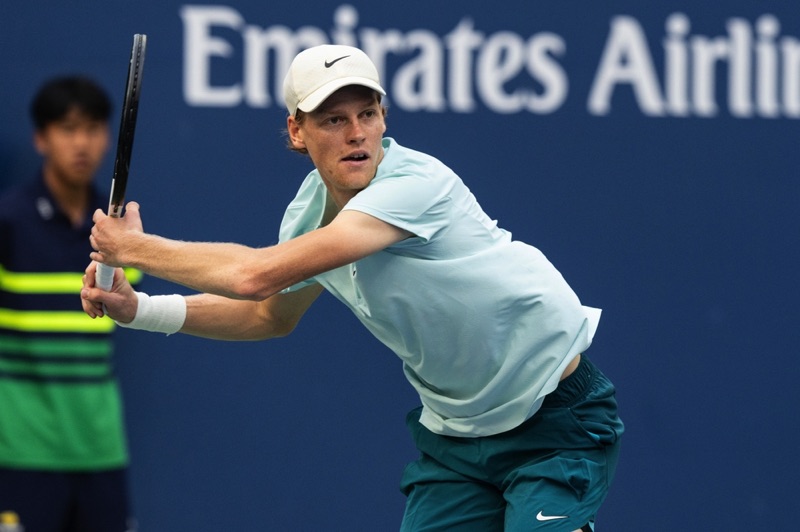
Sinner’s playing style is built around early ball striking, clean timing and controlled aggression from both wings. His backhand is particularly reliable, allowing him to absorb pace and redirect the ball without giving up his position near the baseline.
That ability to take the ball early reduces an opponent’s reaction time and helps Sinner control rallies without relying on constant changes of strategy. His game is repeatable, efficient and highly suited to hard courts.
Alcaraz presents a different challenge. His style combines explosive movement and forehand power with drop shots, slices, changes of pace and frequent approaches to the net. His ability to turn defence into attack gives him more ways to disrupt an opponent who has begun controlling the baseline.
The 2025 US Open final showed how effective that variety can be against Sinner. Alcaraz prevented him from settling into predictable exchanges, attacked with greater freedom and used different court positions to change the rhythm of the match.
The comparison is therefore between consistency and versatility. Sinner offers a repeatable and highly efficient baseline game, while Alcaraz has a broader range of tactical options when the initial pattern of a match is not working.
Who Has the Stronger Serve-and-Return Combination?
Serving and returning efficiently are especially important during a seven-match hard-court Grand Slam. Shorter service games conserve energy, while strong returning prevents opponents from moving comfortably through their own games.
Sinner’s serve has improved substantially in recent seasons. He uses placement and variation to begin points on favourable terms rather than relying on speed alone. His ability to follow the serve with an early, aggressive groundstroke often allows him to take control within the first few shots.
His return position is another major strength. Sinner frequently takes the ball early and directs it deep through the middle or into the corners, immediately reducing the server’s time.
Alcaraz has also improved his serve and increasingly uses it to set up his forehand. His ability to attack second serves is particularly dangerous because he can step inside the baseline and turn a neutral point into an offensive one.
Sinner may have the more repeatable serve-and-return profile across an entire tournament. However, Alcaraz can be more disruptive when he is returning confidently and using his variety to prevent the server from anticipating his position.
Who Is Better Equipped for Five-Set Matches?
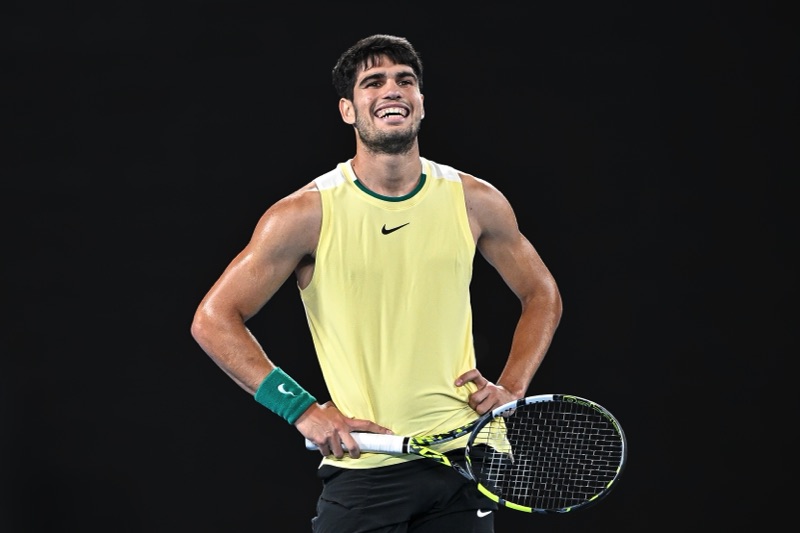
Five-set suitability involves more than raw endurance. Efficient service games, controlled emotions and the ability to avoid unnecessary early-round battles are all important during the second week of a Grand Slam.
Alcaraz has repeatedly demonstrated an ability to recover from difficult positions in long matches. He can change tactics after losing a set, increase his aggression and use his movement to reverse momentum.
His five-set record at majors has historically been exceptional, although any exact win-loss figure must be dated because it changes as further matches are played. The broader point remains clear: Alcaraz is comfortable in extended contests and rarely appears defeated simply because a match has become physically or emotionally difficult.
Sinner was less successful in deciding sets earlier in his career, but his more efficient style often allows him to avoid reaching a fifth set. When his serve and baseline timing are working, he can progress through matches without the same level of physical disruption.
Alcaraz has the stronger history of surviving chaotic five-set contests. Sinner’s advantage is that his structured game may reduce the likelihood of such contests occurring in the first place.
Current Form Could Decide the Comparison
Historical results explain each player’s suitability, but the final assessment must also account for their condition immediately before the tournament.
Sinner enters the second half of 2026 with greater competitive continuity. He regained the world No. 1 ranking during the spring and won the opening four Masters 1000 events of the season at Indian Wells, Miami, Monte-Carlo and Madrid. He then successfully defended his Wimbledon title in July.
Those results give Sinner sustained match rhythm and confidence across different surfaces. His serve, early ball striking and hard-court efficiency make him a natural favourite heading towards New York.
Alcaraz’s preparation is less certain. A right-wrist injury kept him out of the 2026 French Open and Wimbledon, and he is expected to return at the Cincinnati Open after approximately three months away from competition. Tournament entry does not guarantee that he will immediately recover his usual timing, confidence or physical durability.
Alcaraz had already strengthened his season by winning the 2026 Australian Open, but the wrist problem interrupted his competitive rhythm later in the year.
The North American hard-court events will therefore be especially important. If Alcaraz returns without discomfort and completes several competitive matches, the comparison will become much closer. If his preparation remains limited, Sinner will enter the US Open with the more reliable foundation.
Final Verdict: Who Is Better Suited to Win?
Carlos Alcaraz to Jannik Sinner after beating him in the U.S. Open final
“I wanna start with Jannik. It’s unbelievable what you’re doing during the whole season. Great level every tournament you’re playing. I’m seeing you more than my family”
😭😭😭😭😭😭 pic.twitter.com/wkIPkTqRU9
— The Tennis Letter (@TheTennisLetter) September 7, 2025
Alcaraz has the higher tactical ceiling because of his movement, forehand, variety and ability to disrupt Sinner’s preferred patterns. His two US Open titles and direct victories over Sinner in New York also give him the stronger tournament record.
Sinner may possess the more repeatable hard-court profile. His early timing, baseline control, serving efficiency and ability to maintain a consistent level make him particularly well suited to progressing through a seven-match tournament.
In a direct matchup, Alcaraz may have the advantage when he serves well and successfully varies the rallies. Across the tournament as a whole, Sinner may be the safer choice when he is healthy, confident and controlling his service games efficiently.
Based on their preparation as of July 2026, Sinner appears to be the more reliable US Open selection. He has greater competitive continuity, while Alcaraz is still returning from a significant wrist-related absence.
That conclusion is not permanent. A healthy and match-sharp Alcaraz would remain one of the leading contenders, and his performances during the North American warm-up events could quickly change the assessment.