
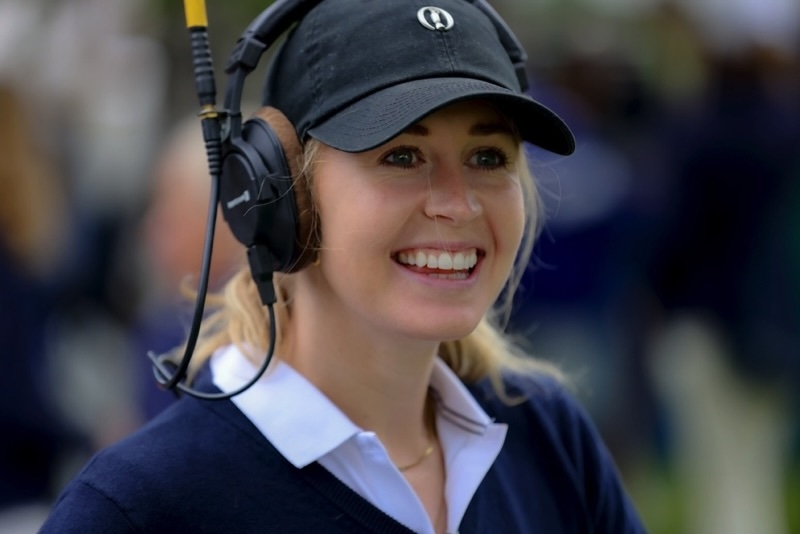
Iona Stephen didn’t take up golf properly until she got to university. Four years later, she had turned professional and eighteen months after that, a long-term problem with arthritis in her wrist ended her playing career before it had really started.
Most stories that begin like that do not lead to one of the steadier voices in modern golf broadcasting, but Stephen’s has, thanks to the faith shown in her by the powers that be at Sky Sports Golf and her own ability to explain things simply and clearly for the viewers at home that might only watch golf when the Majors come around, allowing her to become one of the sport’s most recognisable voices.
Stephen in the Media
Stephen joined Sky Sports’ golf presenting team in the July of 2019 on a contract basis, becoming a regular on the network’s coverage of the women’s game in particular over the years that followed. By 2020, her role had broadened to include the men’s circuit and in 2021 she joined the BBC’s commentary team for the first men’s Major of the year, the Masters at Augusta. Her work has since extended to CBS coverage of the PGA Tour in the United States of America, making her one of the few golf broadcasters working regularly across the British and American networks covering the likes of the Open Championship and the Solheim Cup.
Draws on Her Own Experience
Her style on air leans on a different set of credentials from those of most of her colleagues. Whereas many of her fellow broadcasters tend to draw on decades of Tour experience, which is understandable when you’re talking about names such as Sir Nick Faldo and Colin Montgomerie, Stephen draws on her own training as a player, a sports nutrition diploma, a level 2 personal trainer qualification and a willingness to bring the technical detail of swing mechanics and player conditioning into the conversation in a way that the more conventional ex-Tour pundit might not. The result is a presence that has been well received in the women’s game.
Sky Sports
That is thanks to the fact that the less common viewer of golf broadcasting tends to be an audience that values a broadcaster who can speak knowledgeably about the actual mechanics of what is happening on the course. Her own platform has also grown substantially in the years since she joined Sky Sports. Her YouTube channel and the other media work she runs around the broadcasting contracts, in which she interviews players, equipment companies and figures across the wider game, has become a significant part of her output and is one of the things that distinguishes her from broadcasters who work only inside the networks that employ them.
YouTube
Her Chasing the Red series, in which she attempts to break par on some of the world’s toughest courses, has proven to be a big hit for YouTube viewers. She has also been a regular keynote speaker on subjects ranging from female participation in the sport of golf through to the commercial and cultural shifts that golf has undergone in the years since the arrival of the Saudi Arabian-backed LIV Golf. The cumulative effect is of a broadcaster who has built something closer to a small media business around herself more than what we might have come to expect of a conventional contract presenter.
Stephens the Golfer
Long before she had ever swung a club seriously, Iona Stephen was a junior international competitor in four different sports, which were squash, hockey, lacrosse and athletics. She attended St George’s School in Edinburgh and went on to read History of Art at the University of St Andrews, where she was offered a place in a sport transfer scheme that allowed her to take up golf as a new discipline. By her own admission, she had picked the sport up almost by accident, but her natural athletic background and the location of the university, which gave her access to some of the best courses and coaching in the world, meant that the progression from beginner to serious player was quick.
Things might have been different had she gone through with her original plan to swap hockey for squash in time to win a medal for Scotland at the Commonwealth Games in 2014. Instead, she had to beg the organisers to allow her to play golf after she fell in love with the sport in the wake of going to the Women’s Open, held at Carnoustie. She was convinced that she could be good at the sport, in spite of the fact that she hadn’t even hit a golf ball at the time. It is fair to say that she knew her abilities well, given the success that she went on to achieve in her brief golfing career as well as her media work in the years after.
Across four years as an amateur, she got her handicap down to plus three and broke the course records at three different clubs, which is an unusual record for a player who had only seriously started playing in her late teens. She turned professional in 2016 and made her debut on the Ladies European Tour at the Qatar Ladies Open later that year. The late start and the immediate exposure to professional play might have been a great deal less successful than they turned out to be, with Stephen managing to hold her own against players who had been on the circuit for a decade or more, in part thanks to her natural athleticism.
The arthritis in her wrist that sadly ended that side of her career arrived approximately 18 months into her professional life. The recovery did not allow her to return to the level of play that the Tour required, so she made the decision to step away from competitive golf rather than try to grind out a marginal existence at the lower end of the women’s professional game. The move into broadcasting followed almost immediately, with Stephen drawing on her playing knowledge, her academic background and the social media following she had built during her time as a player to put together a successful media career entirely on her own terms.