
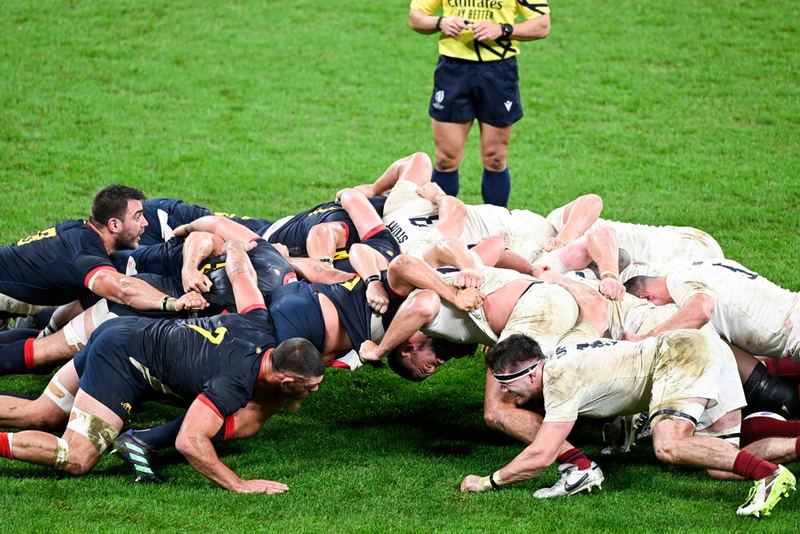
England suffered football World Cup heartbreak against Argentina last week, but Steve Borthwick’s side ensured there was at least one sporting victory for the nation to enjoy. In rugby, England beat Los Pumas 31-24 during a chaotic Nations Championship encounter.
Both contests highlighted just how fiercely these nations compete, with discipline proving an issue in each. The rugby match saw seven yellow cards, while the World Cup semi-final featured four bookings – a surprisingly low tally given the physical and ill-tempered nature of the contest.
England Claim Rugby Revenge
Argentina set the tone for the clash in Santiago del Estero by taking to the field in a navy blue striped kit reminiscent of the one the football team wore to win the 1986 World Cup. It was a clear nod to one of the most infamous matches in football history, when Diego Maradona inspired Argentina to victory over England, with a helping hand from God of course.
This did not end up rattling the visitors, though, as England raced into a commanding lead through an impressive attacking display. By half-time the score stood at 19-3 thanks to two tries from Ben Earl and another from Tommy Freeman. It seemed as though England were set for a comfortable evening before their discipline almost undid their hard work.
Four second-half yellow cards left the visitors scrambling to hold onto their advantage, with repeated trips to the sin bin reducing them to 13 players for periods of the second half. Argentina took advantage to mount a late comeback, but England’s defence just about stood firm enough to secure victory. Things could have been different though had Bautista Delguy’s 83rd-minute try not been controversially chalked off.
Had the officials awarded the try, which was referee Angus Gardner’s original decision, Argentina would have been left with a tricky conversion to tie the match.
Football Heartbreak in the World Cup
Over in the football, late drama went Argentina’s way as they edged out England 2-1 in a dramatic World Cup semi-final. In doing so, they ended the Three Lions’ hopes of reaching a first final since 1966. It was a fiercely contested encounter from the opening whistle, with neither side willing to give an inch.
Such was the cagey nature of the match that only three shots were recorded before the break, with the two sides combining for a meagre 0.07 xG. This is a stark contrast to what was a quite end-to-end rugby match featuring seven tries. Chances only began to flow after England broke the deadlock in the 55th minute. The Three Lions retreated into their own half to protect their lead, but were unable to repel the relentless Argentine pressure.
Although only four yellow cards were shown throughout the match, the contest was far more physical than that figure suggests. There were 19 fouls in the first half alone as tackles flew in and tempers threatened to boil over. One of these fouls saw Enzo Fernandez strike Elliot Anderson in the back of his head. The midfielder escaped without a booking, but many felt the challenge could have warranted a red card.
A Rivalry That Rarely Disappoints
It should perhaps come as little surprise that both fixtures were played in such a combative fashion. England and Argentina share one of international sport’s fiercest rivalries, one shaped by decades of political tension and unforgettable sporting encounters. The bitterness surrounding the 1986 World Cup quarter-final, featuring Diego Maradona’s infamous ‘Hand of God’ goal, remains the defining chapter, at least from a sporting point of view.
Rugby has developed its own fierce edge in recent years. Argentina’s rise into one of the southern hemisphere’s strongest nations has led to very competitive affairs. Although England have won 11 of the 12 matches played this decade, half of the games were won by seven points or fewer.
Given the World Cup once again shone a spotlight on the Falklands dispute, it is hard to imagine the rivalry dying out any time soon.
Discipline Is Becoming England’s Rugby Problem
While the rivalry undoubtedly contributed to Saturday’s heated contest, England’s disciplinary issues have become a worrying trend rather than an isolated incident. Borthwick’s side have now received 14 yellow cards and one red card in just eight matches during 2026. Only once in that run, against Fiji, have England completed a match without a player being sent to the sin bin.
| Player | Opponent | Time | Card |
|---|---|---|---|
| Emmanuel Iyogun | Argentina | 76′ | Yellow |
| Henry Pollock | Argentina | 72′ | Yellow |
| Alex Coles | Argentina | 54′ | Yellow |
| Jack van Poortvliet | Argentina | 50′ | Yellow |
| Guy Pepper | South Africa | 71′ | Yellow |
| Tommy Freeman | South Africa | 69′ | Yellow |
| Ellis Genge | France | 41′ | Yellow |
| Maro Itoje | Italy | 63′ | Yellow |
| Sam Underhill | Italy | 54′ | Yellow |
| Henry Pollock | Ireland | 41′ | Yellow |
| Henry Arundell | Scotland | 36′ | Red |
| Henry Arundell | Scotland | 7′ | Yellow |
| Tom Curry | Wales | 75′ | Yellow |
| Maro Itoje | Wales | 50′ | Yellow |
If England are serious about competing with the world’s best, they cannot continue playing significant portions of matches a player down.
Argentina’s Footballers Have Their Own Discipline Issues
England’s rugby side are not the only team struggling to keep their discipline. Argentina’s footballers have developed a similar reputation during the World Cup. They committed an average of 14.1 fouls per match, the fourth-highest figure in the tournament. They also, despite some lenient refereeing, collected 13 yellow cards, more than any other nation.
Argentina’s disciplinary issues were not confined to fouls and bookings either. Emotions spilt over after Enzo Fernández’s equaliser when substitute Facundo Barco ran onto the pitch to taunt the England players. Later on, in the final with Spain, Nahuel Molina punched Rodri and Leandro Paredes shoved Eric Garcia in the throat after the final whistle. Maybe the football players should give rugby a go!